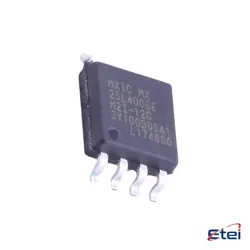
Imagens apenas para referência
24LC64-I/P
+Lista de MateriaisIC EEPROM 64KBIT I2C 400KHZ 8DIP
-
FabricanteTecnologia Microchip
-
Peça do Fabricante #24LC64-I/P
-
Ficha Técnica 24LC64-I/P DataSheet
-
Pacote PDIP-8
-
Em Estoque5381
365 Garantia de Qualidade em 1 dia
7*24 Garantia de serviço em 24 horas
90-Garantia de pós-venda em 1 dia
Garantia de Produto Genuíno
Especificações
| Atributo | Valor |
| Package | Tube |
| ProductStatus | Active |
| MemoryType | Non-Volatile |
| MemoryFormat | EEPROM |
| Technology | EEPROM |
| MemorySize | 64Kb (8K x 8) |
| MemoryInterface | I²C |
| ClockFrequency | 400 kHz |
| WriteCycleTime-WordPage | 5ms |
| AccessTime | 900 ns |
| Voltage-Supply | 2.5V ~ 5.5V |
| OperatingTemperature | -40°C ~ 85°C (TA) |
| MountingType | Through Hole |
| Package/Case | 8-DIP (0.300, 7.62mm) |
Visão Geral
Description
Key features include a hardware write-protect pin, which safeguards the entire memory array, and a page write capability of up to 32 bytes. The 24LC64-I/P has a low power consumption, with a standby current of just 1 µA, ideal for battery-powered devices. It is available in a PDIP (Plastic Dual In-line Package), providing easy mounting and prototyping.
The EEPROM is suitable for data storage needs where non-volatile memory is required, such as calibration tables, configuration data, and serial numbers in consumer electronics, industrial, automotive, and medical applications. Its reliability is enhanced by high endurance, supporting over 1 million erase/write cycles with data retention of over 200 years.
Equivalent
1. STMicroelectronics M24C64-WMN6TP
2. Atmel/Microchip AT24C64D
3. ON Semiconductor CAT24C64
4. ROHM BR24G64
5. Renesas Electronics R1EX2464
These alternatives offer similar memory capacity and I2C interface compatibility. Always check datasheets for specific details on electrical characteristics and pin configurations to ensure compatibility with your design.
Features
1. I2C Interface: Supports I2C communication protocol, allowing for easy integration with microcontrollers.
2. Voltage Range: Operates over a wide voltage range of 2.5V to 5.5V.
3. Low Power Consumption: Features low standby current and low active read/write currents, making it energy-efficient.
4. Data Retention: Offers data retention of over 200 years, ensuring long-term reliability.
5. Endurance: Supports over 1 million erase/write cycles per memory cell.
6. Organization: Arranged in 8K x 8 bits, providing structured data storage.
7. Page Write Capability: Can write up to 32 bytes in a single page write operation.
8. Temperature Range: Operates over a wide temperature range, accommodating various environmental conditions.
9. Package: Available in PDIP, SOIC, TSSOP, and other package types for different design requirements.
These features make the 24LC64-I/P suitable for applications like data logging, configuration settings, and other non-volatile storage needs.
Pinout
1. A0, A1, A2 (Pins 1, 2, 3): These are address pins used for device selection. They allow up to eight 24LC64 devices to be connected on the same I²C bus.
2. VSS (Pin 4): This is the ground pin.
3. SDA (Pin 5): The Serial Data line is a bidirectional pin used for transferring data to and from the memory.
4. SCL (Pin 6): The Serial Clock line is used to synchronize data transfer between the EEPROM and the controller.
5. WP (Pin 7): The Write-Protect pin can be used to enable or disable writing to the memory. When connected to VCC, the write operations to the entire memory are inhibited.
6. VCC (Pin 8): This is the power supply pin, typically connected to a positive voltage (2.5V to 5.5V).
These pins collectively allow the 24LC64 to operate on an I²C bus for reading and writing data.
Manufacturer
Application
1. Consumer Electronics: For storing configuration or calibration data in devices like TVs, cameras, and audio equipment.
2. Industrial Control: Used in programmable logic controllers (PLCs) and other control systems for storing settings and operational parameters.
3. Automotive: For data logging and storage of vehicle parameters.
4. Computing: In laptops and PCs for BIOS storage and configuration data.
5. Medical Devices: For storing patient data and device settings.
These applications benefit from its non-volatile memory, small footprint, and reliable data retention.