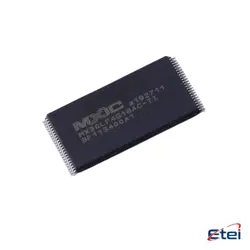
Imagens apenas para referência
AM26C32CD
+Lista de MateriaisIC RECEIVER 0/4 16SOIC
-
FabricanteTexas Instruments
-
Peça do Fabricante #AM26C32CD
-
Pacote SOIC-16
-
Em Estoque1368
365 Garantia de Qualidade em 1 dia
7*24 Garantia de serviço em 24 horas
90-Garantia de pós-venda em 1 dia
Garantia de Produto Genuíno
Especificações
| Atributo | Valor |
| Package | Bulk,Tube |
| ProductStatus | Active |
| Type | Receiver |
| Protocol | RS422, RS423 |
| NumberofDrivers/Receivers | 0/4 |
| ReceiverHysteresis | 60 mV |
| Voltage-Supply | 4.5V ~ 5.5V |
| OperatingTemperature | 0°C ~ 70°C |
| MountingType | Surface Mount |
| Package/Case | 16-SOIC (0.154, 3.90mm Width) |
Visão Geral
Description
Key features of the AM26C32CD include low power consumption, high input impedance, and the ability to operate over a wide range of supply voltages. It provides four independent differential receivers, each capable of converting differential input signals to TTL-compatible outputs. This makes it ideal for systems that need to interface with TTL or CMOS logic circuits.
The AM26C32CD offers enhanced noise immunity and can function effectively in environments with significant electromagnetic interference. It is commonly used in industrial automation, telecommunications, and computer networking. The device is packaged in a compact SOIC-16 form factor, making it suitable for applications where space is limited and reliability is critical.
Equivalent
1. SN75173 by Texas Instruments
2. MC3486 by ON Semiconductor
3. DS26C32A by Texas Instruments
4. MAX489 by Maxim Integrated
5. LTC485 by Analog Devices
These chips offer similar functionalities and can often be used interchangeably in various applications requiring differential signal reception. Always check the datasheets for compatibility with your specific design requirements.
Features
1. High-Speed Operation: It supports high-speed data transmission, making it suitable for fast communication requirements.
2. Wide Supply Voltage Range: The device operates over a broad supply voltage range, enhancing its versatility in various applications.
3. Low Power Consumption: It is designed for low power usage, which is beneficial for battery-powered and energy-efficient systems.
4. High Input Impedance: The receiver has a high input impedance, which allows for multiple receivers to be connected to the same data line without degrading signal integrity.
5. Differential Input: The AM26C32CD features differential inputs that provide excellent noise immunity, a crucial factor in maintaining data integrity over long distances or in noisy environments.
6. Built-in Hysteresis: This feature improves noise rejection and signal integrity by preventing false triggering due to noise or slow input transitions.
7. Fail-Safe Operation: It ensures a known output state when the input signal is open, shorted, or terminated.
These features make the AM26C32CD ideal for robust and reliable data communication in industrial, automotive, and telecommunications applications.
Pinout
Here is a concise description of the pin functions:
1. VCC (Pin 16): Power supply pin.
2. GND (Pin 8): Ground pin.
3. A, B, C, D (Pins 2, 6, 10, 14): Non-inverting inputs for each of the four receivers.
4. A̅, B̅, C̅, D̅ (Pins 3, 5, 11, 13): Inverting inputs for each of the four receivers.
5. Y, Z, W, X (Pins 1, 7, 9, 15): Outputs corresponding to each pair of differential inputs.
6. Enable Pins (not always outlined in standard pinout diagrams): Depending on the specific version or configuration, there may be additional pins for enabling/disabling the receivers.
The AM26C32CD is commonly used in applications requiring robust data transmission with noise immunity, thanks to its differential input design.
Manufacturer
Application
1. RS-422 and RS-485 Interfaces: Used in communication systems requiring differential signaling.
2. Industrial Automation: Facilitates reliable data transmission in noisy environments.
3. Data Acquisition Systems: Collects and processes data from remote sensors.
4. Networking Equipment: Supports robust network connections over extended distances.
5. Telecommunications: Ensures accurate data transfer in telecom infrastructure.
6. Instrumentation: Provides reliable communication in test and measurement devices.
These applications benefit from its high input impedance, low power consumption, and wide common-mode voltage range.