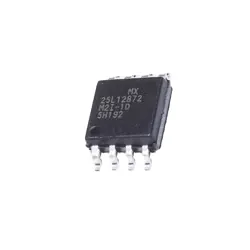
Imagens apenas para referência
ATTINY102F-SSNR
+Lista de MateriaisIC MCU 8BIT 1KB FLASH 8SOIC
-
FabricanteTecnologia Microchip
-
Peça do Fabricante #ATTINY102F-SSNR
-
Ficha Técnica ATTINY102F-SSNR DataSheet
-
Em Estoque2291
365 Garantia de Qualidade em 1 dia
7*24 Garantia de serviço em 24 horas
90-Garantia de pós-venda em 1 dia
Garantia de Produto Genuíno
Especificações
| Atributo | Valor |
| Series | AVR® ATtiny |
| Part Status | Active |
| Digi Key Programmable | Not Verified |
| Core Processor | AVR |
| Core Size | 8-Bit |
| Speed | 12MHz |
| Connectivity | UART/USART |
| Peripherals | POR, PWM, WDT |
| Number of I/O | 6 |
| Program Memory Size | 1KB (1K x 8) |
| Program Memory Type | FLASH |
| RAM Size | 32 x 8 |
| Voltage - Supply (Vcc/Vdd) | 1.8V ~ 5.5V |
| Data Converters | A/D 5x10b |
| Oscillator Type | Internal |
| Operating Temperature | -40°C ~ 105°C (TA) |
| Mounting Type | Surface Mount |
| Supplier Device Package | 8-SOIC |
| Package / Case | 8-SOIC (0.154", 3.90mm Width) |
| Base Product Number | ATTINY102 |
Visão Geral
Description
This microcontroller operates at a maximum clock frequency of 12 MHz and includes key peripherals such as ADC (Analog-to-Digital Converter), timers, and I/O pins, which facilitate various interfacing tasks. It also supports serial communication through USART, SPI, and I2C, allowing connectivity with other devices and sensors. The ATTINY102F-SSNR is typically used in small-scale projects such as wearable devices, home automation, and consumer electronics where low power and size constraints are critical. Additionally, it features robust security and protection mechanisms, making it a reliable choice for developers in need of a small yet effective microcontroller solution.
Equivalent
1. Microchip ATtiny85 - Offers similar functionality with 8-bit AVR architecture.
2. STMicroelectronics STM8S003F3 - Another 8-bit microcontroller with comparable features.
3. NXP LPC810 - ARM Cortex-M0+ based option for low-power applications.
4. Silicon Labs EFM8BB10F2G - 8-bit microcontroller from the EFM8 Busy Bee family.
These alternatives provide similar capabilities in terms of processing power and peripheral support.
Features
1. Core: Based on an 8-bit AVR RISC (Reduced Instruction Set Computing) architecture, offering swift performance with low power consumption.
2. Program Memory: It comes with 1KB of Flash memory, allowing for storage of program code.
3. Data Memory: Includes 32 Bytes of SRAM for data handling and processing.
4. EEPROM: Contains 128 Bytes of EEPROM for non-volatile data storage.
5. I/O Pins: Offers 6 I/O pins for versatile interfacing with other devices and components.
6. Operating Voltage: Functions effectively within a voltage range of 1.8V to 5.5V.
7. Speed: Can operate at speeds up to 12 MHz, depending on the voltage.
8. Peripherals: May include features like timers, watchdog timer, internal oscillator, and more to facilitate various applications.
9. Package: Typically housed in a small SOT-23 package, ideal for space-constrained applications.
This microcontroller is widely used in applications requiring a small footprint and efficient processing, including embedded systems and IoT devices.
Pinout
1. VCC: Power supply pin.
2. GND: Ground pin.
3. PB0 - PB5: These are general-purpose I/O pins, which can also serve as peripheral functions such as ADC inputs, PWM outputs, or other specialized functions depending on software configuration.
4. RESET: This pin can be used to reset the microcontroller, but it can also be configured for general I/O depending on the requirement.
Each pin's function can be configured via the software, allowing flexibility in how the microcontroller interfaces with other devices and systems.
Manufacturer
Application
1. IoT Devices: Ideal for simple, low-power IoT devices requiring basic processing.
2. Consumer Electronics: Used in gadgets and appliances for basic control functionalities.
3. Sensor Interfaces: Acts as an interface for various sensors in monitoring systems.
4. Wearables: Perfect for compact, battery-operated wearable technology.
5. Control Systems: Employed in small-scale control systems for automation.
6. Toys and Educational Kits: Used in interactive toys and DIY electronics projects.
Its versatility and efficiency make it popular in developing innovative and cost-effective solutions.