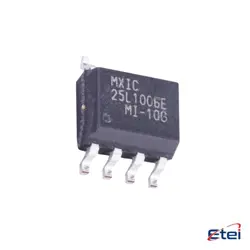
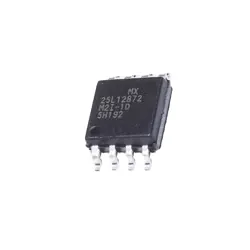
Imagens apenas para referência
CS82C54-12
+Lista de MateriaisIC OSC PROG TIMER 12MHZ 28PLCC
-
FabricanteRenesas Electronics America Inc.
-
Peça do Fabricante #CS82C54-12
-
Pacote 28-LCC (J-Lead)
-
Em Estoque7301
365 Garantia de Qualidade em 1 dia
7*24 Garantia de serviço em 24 horas
90-Garantia de pós-venda em 1 dia
Garantia de Produto Genuíno
Especificações
| Atributo | Valor |
| Supplier | Renesas Electronics America Inc |
| Package | Tube |
| ProductStatus | Obsolete |
| Type | Programmable Timer |
| Frequency | 12MHz |
| Voltage-Supply | 4.5V ~ 5.5V |
| Current-Supply | 10 mA |
| OperatingTemperature | 0°C ~ 70°C |
| Package/Case | 28-LCC (J-Lead) |
| SupplierDevicePackage | 28-PLCC (11.51x11.51) |
Visão Geral
Description
Each counter can be programmed to operate in one of six modes, including interrupt on terminal count, hardware triggered strobe, and rate generation. The device supports binary or BCD counting and is suitable for applications like clock generation, complex event timing, and pulse width modulation.
Equivalent
1. Intel 82C54 - A similar programmable interval timer from Intel.
2. Harris/Intersil 82C54 - Another variation of the 82C54 timer series.
3. AMD Am82C54 - Equivalent timer from AMD.
4. NEC μPD71054 - NEC's version of the programmable timer.
5. Philips/Signetics 82C54 - A compatible model by Philips/Signetics.
These variants offer similar functionalities and are typically interchangeable depending on specific system requirements.
Features
Key features of the CS82C54-12 include:
1. Frequency Range: It operates up to 12 MHz, allowing for high-speed counting and timing operations.
2. Programmable: Each counter can be individually programmed for different modes, including binary or BCD counting.
3. Compatibility: It is pin-compatible with the industry-standard 8254, making it suitable for integration into existing systems.
4. Versatility: The device supports interrupt on terminal count, which can be used for precise control in real-time applications.
5. Power Supply: It typically requires a single +5V power supply.
6. Package Options: Available in various package types to suit different design requirements.
These features make the CS82C54-12 suitable for use in embedded systems, industrial control, and instrumentation applications.
Pinout
The CS82C54-12 has a 24-pin dual in-line package (DIP). Its primary function is to provide three independent 16-bit counters, each capable of operating in various modes such as event counting, rate generation, and time interval measurement. These counters can be programmed by the user for different functions, which makes it versatile for various timing applications.
The pinout includes connections for data bus (D0-D7), control and status signals, counter outputs, and clock inputs. Important pins include the control input (CS, RD, WR) for interfacing with a microprocessor, and the clock inputs (CLK0, CLK1, CLK2) for each of the three counters. The outputs (OUT0, OUT1, OUT2) provide the timer signals based on programmed operation modes.
Overall, the CS82C54-12 is widely used in embedded systems where precise timing and control signals are needed.
Manufacturer
Intersil's product range before the acquisition included power management ICs, analog and mixed-signal ICs, and other semiconductor devices catering to applications in computing, consumer electronics, industrial, automotive, and communications sectors. The CS82C54-12 itself is a programmable interval timer, designed for use in microcomputer systems to manage timing functions.
Renesas Electronics, the parent company following the acquisition, is a Japanese semiconductor manufacturer that is considered one of the world's largest suppliers of microcontrollers and one of the prominent producers of advanced semiconductor solutions, including system-on-chip (SoC) platforms, power management solutions, and more. The merger aimed to enhance Renesas's offerings, especially in analog and power management areas, leveraging Intersil's expertise and product portfolio.
Application
1. Embedded Systems: Utilized for generating precise time delays and event counting.
2. Microcontroller Systems: Used for timekeeping, scheduling tasks, and generating periodic interrupts.
3. Communication Systems: Assists in baud rate generation and synchronization tasks.
4. Instrumentation: Provides accurate timing for measuring intervals and durations.
5. Industrial Automation: Used in control systems requiring precise timing for processes and operations.
Its versatility and programmability make it suitable for a wide range of timing-related tasks in various electronic systems.