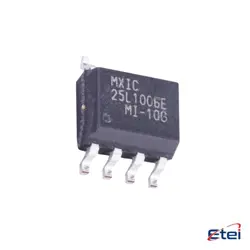
Imagens apenas para referência
DS1302Z+
+Lista de MateriaisIC RTC CLK/CALENDAR SER 8SOIC
-
FabricanteAnalog Devices Inc./Maxim Integrated
-
Peça do Fabricante #DS1302Z+
-
Em Estoque4648
365 Garantia de Qualidade em 1 dia
7*24 Garantia de serviço em 24 horas
90-Garantia de pós-venda em 1 dia
Garantia de Produto Genuíno
Especificações
| Atributo | Valor |
| Part Status | Active |
| Base Product Number | DS1302 |
| Digi Key Programmable | Not Verified |
| Type | Clock/Calendar |
| Features | Leap Year, NVSRAM, Trickle-Charger |
| Memory Size | 31B |
| Time Format | HH:MM:SS (12/24 hr) |
| Date Format | YY-MM-DD-dd |
| Interface | 3-Wire Serial |
| Voltage - Supply | 2V ~ 5.5V |
| Voltage - Supply, Battery | 2V ~ 5.5V |
| Current - Timekeeping (Max) | 0.3µA ~ 1µA @ 2V ~ 5V |
| Operating Temperature | 0°C ~ 70°C |
| Mounting Type | Surface Mount |
| Package / Case | 8-SOIC (0.154", 3.90mm Width) |
| Supplier Device Package | 8-SOIC |
| Packaging | Tube |
Visão Geral
Description
### Key Features:
- Serial interface (3-wire SPI-compatible) for easy microcontroller integration.
- Battery backup support for continuous timekeeping during power loss.
- Low power consumption (~300nA in backup mode).
- Operates from 2.0V to 5.5V, making it suitable for 3V/5V systems.
- 31 x 8 bytes of general-purpose RAM for additional data storage.
### Applications:
- Embedded systems
- Digital clocks
- Data loggers
- Battery-powered devices
The DS1302Z+ is a cost-effective RTC but lacks temperature compensation, which may affect long-term accuracy. For improved precision, consider the DS3231.
Would you like pinout or wiring details?
Pinout
1. VCC2 (Pin 1) – Primary power supply.
2. X1 (Pin 2) & X2 (Pin 3) – Connections for a 32.768kHz crystal.
3. GND (Pin 4) – Ground.
4. CE (Pin 5) – Chip enable (active high).
5. I/O (Pin 6) – Serial data input/output.
6. SCLK (Pin 7) – Serial clock input.
7. VCC1 (Pin 8) – Backup power supply (for battery backup).
It communicates via a 3-wire serial interface (CE, I/O, SCLK) and provides timekeeping with seconds, minutes, hours, date, month, day, and year data. The DS1302Z+ operates at 2V–5.5V and includes trickle-charge capability for backup power.
Application
1. Consumer Electronics – Clocks, timers, and appliances.
2. Embedded Systems – Microcontroller-based projects needing timekeeping.
3. Industrial Automation – Data logging and event scheduling.
4. Automotive – Dashboard clocks and diagnostic tools.
5. IoT Devices – Battery-backed time tracking for sensors.
It provides low-power, accurate time/date functions with serial communication, making it suitable for battery-operated and space-constrained applications.
Frequently Asked Questions
Q: What is the typical power consumption of the DS1302Z+ in timekeeping mode?
A: The current consumption is extremely low, ranging from 0.3μA to 1μA at 2V to 5V supply, making it ideal for battery-backed applications.
Q: Does this RTC support a backup battery for maintaining time during power loss?
A: Yes, it features a trickle-charger circuit and supports a battery supply voltage of 2V to 5.5V, enabling seamless timekeeping when main power is removed.
Q: How is the time and date data communicated to a microcontroller?
A: It uses a 3-wire serial interface (CE, I/O, SCLK), which simplifies connection and reduces pin count compared to parallel RTCs.
Q: What is the memory size available for saving user data?
A: The DS1302Z+ includes 31 bytes of NVSRAM (non-volatile static RAM) for storing configuration or event data, retained via the backup battery.
Q: Can this RTC handle leap year corrections automatically?
A: Yes, it features a Leap Year validation circuit, allowing it to automatically adjust for February 29th in leap years without manual intervention.
Q: What time and date formats are supported by the DS1302Z+?
A: It supports both 12-hour (with AM/PM) and 24-hour time formats, as well as date formats in YY-MM-DD-dd (day of the week).
Q: What is the operating temperature range for this part?
A: It is rated for commercial operation from 0°C to 70°C, suitable for indoor and standard industrial environments.