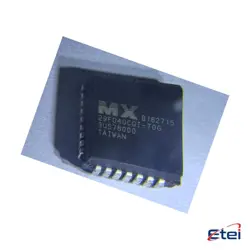
Imagens apenas para referência
M27C1001-12F1
+Lista de MateriaisIC EPROM 1MBIT PARALLEL 32CDIP
-
FabricanteSTMicroeletrônica
-
Peça do Fabricante #M27C1001-12F1
-
Pacote FDIP-32W
-
Em Estoque3328
365 Garantia de Qualidade em 1 dia
7*24 Garantia de serviço em 24 horas
90-Garantia de pós-venda em 1 dia
Garantia de Produto Genuíno
Especificações
| Atributo | Valor |
| Package | Tube |
| ProductStatus | Obsolete |
| MemoryType | Non-Volatile |
| MemoryFormat | EPROM |
| Technology | EPROM - UV |
| MemorySize | 1Mb (128K x 8) |
| MemoryInterface | Parallel |
| AccessTime | 120 ns |
| Voltage-Supply | 4.5V ~ 5.5V |
| OperatingTemperature | 0°C ~ 70°C (TA) |
| MountingType | Through Hole |
| Package/Case | 32-CDIP (0.600, 15.24mm) Window |
Visão Geral
Description
One of its key characteristics is that it is erasable with ultraviolet (UV) light, allowing for reprogramming. This is achieved by exposing the chip's quartz window to UV light, which clears the stored data, after which it can be reprogrammed using a suitable EPROM programmer.
The M27C1001-12F1 is housed in a 32-pin Dual In-line Package (DIP), which is common for ease of integration into circuit boards. It is ideal for applications that require data to be preserved even when the device is powered off, such as in embedded systems, microcontrollers, and other digital electronic devices where firmware updates are occasionally needed.
Equivalent
Pinout
- Power and Ground: VCC (Pin 30) is the power supply, and VSS (Pin 16) is the ground.
- Address Inputs: A0 to A16 (Pins 1-15 and 23) are used to address the memory locations.
- Data Outputs: Q0 to Q7 (Pins 11, 13, 14, 15, 17, 18, 19, 20) provide the data output.
- Control Pins:
- OE (Output Enable): Pin 22, enables data output buffers.
- CE (Chip Enable): Pin 20, activates the chip.
- Programming Pin: VPP (Pin 1) is used for the programming voltage during the programming phase.
This EPROM is mainly used for storing permanent data that can be erased via UV light exposure and reprogrammed.
Manufacturer
Application
1. Firmware storage for microcontrollers and microprocessor systems.
2. Embedded system applications where program updates are infrequent.
3. Legacy systems that require EPROM technology.
4. Prototyping and development environments where reprogrammable memory is beneficial.
5. Industrial and automotive applications needing reliable data retention over extended periods.
This EPROM is particularly useful in systems where low-power operation and long-term data retention are critical.