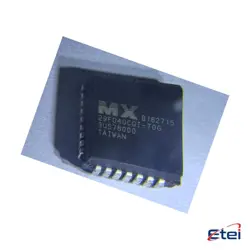
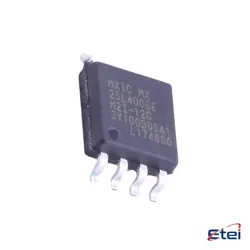
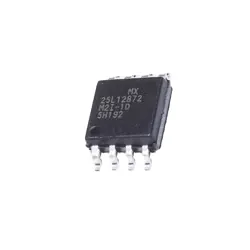
Imagens apenas para referência
MCP23S17-E/ML
+Lista de MateriaisIC I/O EXPANDER SPI 16B 28QFN
-
FabricanteTecnologia Microchip
-
Peça do Fabricante #MCP23S17-E/ML
-
Pacote QFN-28
-
Em Estoque3181
365 Garantia de Qualidade em 1 dia
7*24 Garantia de serviço em 24 horas
90-Garantia de pós-venda em 1 dia
Garantia de Produto Genuíno
Especificações
| Atributo | Valor |
| Package / Case | Tube |
| Part Status | Active |
| Number of I/O | 16 |
| Interface | SPI |
| Interrupt Output | Yes |
| Features | POR |
| Output Type | Push-Pull |
| Current - Output Source / Sink | 25mA |
| Clock Frequency | 10 MHz |
| Voltage - Supply | 1.8V ~ 5.5V |
| Operating Temperature | -40°C ~ 125°C |
| Mounting Type | Surface Mount |
Visão Geral
Description
Key features include two 8-bit ports (A and B), which can be configured as inputs or outputs, and up to 10 MHz SPI clock speed. It supports interrupt-on-change for each pin, allowing efficient detection of input changes without constant polling by the microcontroller. The MCP23S17 also has hardware address pins, enabling the connection of up to eight devices on the same bus.
The "E/ML" suffix denotes its extended temperature range (-40°C to +125°C) and the package type (QFN-28), making it suitable for industrial applications. This I/O expander is ideal for expanding digital I/O in applications such as home automation, instrumentation, and other embedded systems.
Equivalent
1. MCP23S17-E/SS from Microchip, similar features in a different package.
2. MCP23017, similar functionality but utilizes I2C interface.
3. SX1509 from Semtech, a 16-channel I/O expander with additional features like keypad scanning.
4. PCA9535 from NXP, a 16-bit I2C I/O expander.
5. TCA9555 from Texas Instruments, another I2C-based 16-bit I/O expander.
Each alternative may offer different interfaces or packaging.
Features
1. Interface: Utilizes SPI (Serial Peripheral Interface) for communication, allowing efficient data transfer and easy integration with microcontrollers.
2. I/O Configuration: Offers 16-bit I/O port expander capabilities, divided into two 8-bit ports. Each pin can be individually configured as an input or output.
3. Voltage Range: Operates over a wide voltage range from 1.8V to 5.5V, making it suitable for various voltage requirements in different applications.
4. Interrupt Output: Features interrupt output capability to alert the host microcontroller of changes in input state, which is useful for monitoring and control applications.
5. I/O Pin Features: Each I/O pin has internal pull-up resistors, and the device supports features such as polarity inversion, input latch, and interrupt-on-change.
6. Package: Available in a compact QFN-28 package, suitable for space-constrained designs.
7. Compatibility: Compatible with I2C-based MCP23017, providing flexibility in design choices and allowing for easy migration between I2C and SPI interfaces.
Pinout
1. Pins 1-8 (GPIOA0-GPIOA7): General-purpose I/O pins for port A.
2. Pins 9, 10, 11: SPI communication pins:
- Pin 9 (CS): Chip Select (active low).
- Pin 10 (SCK): Serial Clock input.
- Pin 11 (SI): Serial Data In (MOSI).
3. Pin 12 (VSS): Ground.
4. Pin 13 (SO): Serial Data Out (MISO).
5. Pin 14 (RESET): Reset (active low).
6. Pins 15-22 (GPIOB0-GPIOB7): General-purpose I/O pins for port B.
7. Pin 23 (INTB): Interrupt output for port B.
8. Pin 24 (INTA): Interrupt output for port A.
9. Pin 25 (A2): Hardware address pin.
10. Pin 26 (A1): Hardware address pin.
11. Pin 27 (A0): Hardware address pin.
12. Pin 28 (VDD): Power supply.
The chip is designed to provide additional I/O capabilities to microcontroller-based systems, allowing for greater flexibility and control in hardware projects.
Manufacturer
Application
1. Embedded Systems: Enhancing microcontroller I/O capability.
2. Industrial Automation: Controlling multiple sensors and actuators.
3. Consumer Electronics: Expanding I/O for smart home devices.
4. Telecommunications: Managing indicator lights and switches.
5. Automotive Systems: Expanding I/O in dashboard and infotainment systems.
6. Home Automation: Supporting multiple input/output devices.
7. Instrumentation: Interfacing with multiple sensors and control systems.
Its ability to interface via SPI makes it suitable for systems requiring fast data communication.