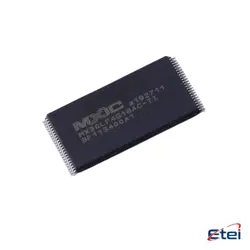
Imagens apenas para referência
S25FL256SAGMFIR03
+Lista de MateriaisIC FLASH 256MBIT SPI/QUAD 16SOIC
-
FabricanteCypress Semiconductor Corp
-
Peça do Fabricante #S25FL256SAGMFIR03
-
Ficha Técnica S25FL256SAGMFIR03 DataSheet
-
Pacote PG-DSO-16
-
Em Estoque7398
365 Garantia de Qualidade em 1 dia
7*24 Garantia de serviço em 24 horas
90-Garantia de pós-venda em 1 dia
Garantia de Produto Genuíno
Especificações
| Atributo | Valor |
| Package / Case | Tape & Reel (TR),Cut Tape (CT) |
| Series | FL-S |
| Part Status | Active |
| Memory Type | Non-Volatile |
| Memory Format | FLASH |
| Technology | FLASH - NOR |
| Memory Size | 256Mb (32M x 8) |
| Memory Interface | SPI - Quad I/O |
| Clock Frequency | 133 MHz |
| Voltage - Supply | 2.7V ~ 3.6V |
| Operating Temperature | -40°C ~ 85°C (TA) |
| Mounting Type | Surface Mount |
Visão Geral
Description
Key features include a standard serial peripheral interface (SPI) that enables communication with a host system, a high-speed read capability supporting frequencies up to 133 MHz, and support for Double Data Rate (DDR) read operations for faster data access. It provides uniform 4-KB sectors, 64-KB sectors, and 256-KB blocks for flexible erase capability, promoting efficient data management.
The S25FL256SAGMFIR03 also includes advanced security features such as secured Silicon Sector regions, block protection, and a password protection mechanism to safeguard data. Power consumption is optimized with deep power-down and standby modes, making it suitable for battery-operated devices. The device operates over a wide temperature range, ensuring reliability in diverse environmental conditions.
Equivalent
1. Micron: MT25QL256ABA
2. Winbond: W25Q256FV
3. Macronix: MX25L25673G
These chips offer similar specifications in terms of memory size, interface, and operating voltage, making them suitable alternatives for similar applications. Always verify pin compatibility and electrical characteristics when substituting.
Features
1. Fast Read/Write Performance: Supports fast read with up to 133 MHz frequency, enabling efficient data access.
2. Quad SPI Interface: Provides a Quad Input/Output (I/O) mode for improved data transfer rates.
3. Sector Erase Capability: Offers flexible erase options with sectors as small as 4KB, allowing for efficient data management.
4. Data Protection: Includes features like block protection and a hardware reset pin to safeguard data integrity.
5. Wide Temperature Range: Operates in temperatures from -40°C to +85°C, suitable for industrial applications.
6. Low Power Consumption: Designed with energy efficiency in mind, supporting deep power-down modes.
7. Endurance and Retention: Guarantees up to 100,000 program/erase cycles per sector with data retention of 20 years.
These features make it ideal for embedded systems requiring reliable and high-speed non-volatile storage.
Pinout
The standard 8-pin configuration includes the following pins:
1. CS# (Chip Select): Activates the device.
2. SO/SIO1 (Serial Output/Serial Data I/O): Outputs data during read operations and can be used for input/output in quad I/O operations.
3. WP#/ACC (Write Protect/Accelerated Input): Protects the memory content, also used for accelerating programming operations.
4. GND (Ground): Ground reference for power supply.
5. SI/SIO0 (Serial Input/Serial Data I/O): Inputs data and commands; used for input/output in quad I/O operations.
6. SCK (Serial Clock): Provides the clock signal for data transfers.
7. RESET# (Reset): Resets the device.
8. VCC (Power Supply Voltage): Powers the device.
This configuration supports serial peripheral interface (SPI) communication and is designed for high-performance and reliability in a variety of applications.
Manufacturer
Application
1. Consumer Electronics: Used in devices like smartphones, tablets, and digital TVs for storage of firmware and application code.
2. Automotive Systems: Provides reliable data storage in infotainment systems, navigation, and ADAS.
3. Industrial Equipment: Utilized for firmware storage in automation systems and industrial controllers.
4. Networking Devices: Supports configuration and software storage in routers, switches, and modems.
5. IoT Devices: Facilitates firmware updates and data logging in smart home and other IoT applications.
Its reliability, speed, and capacity make it suitable for a wide range of embedded system applications.