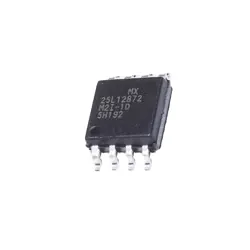
Imagens apenas para referência
TCA9517ADGKR
+Lista de MateriaisIC TRNSLTR BIDIRECTIONAL 8VSSOP
-
FabricanteTexas Instruments
-
Peça do Fabricante #TCA9517ADGKR
-
Pacote VSSOP-8
-
Em Estoque7795
365 Garantia de Qualidade em 1 dia
7*24 Garantia de serviço em 24 horas
90-Garantia de pós-venda em 1 dia
Garantia de Produto Genuíno
Especificações
| Atributo | Valor |
| Package | Tape & Reel (TR),Cut Tape (CT) |
| Series | TCA |
| ProductStatus | Active |
| TranslatorType | Voltage Level |
| ChannelType | Bidirectional |
| NumberofCircuits | 1 |
| ChannelsperCircuit | 2 |
| Voltage-VCCA | 0.9 V ~ 5.5 V |
| Voltage-VCCB | 2.7 V ~ 5.5 V |
| OutputType | Open Drain |
| OperatingTemperature | -40°C ~ 85°C (TA) |
| MountingType | Surface Mount |
| Package/Case | 8-TSSOP, 8-MSOP (0.118, 3.00mm Width) |
Visão Geral
Description
Key features of the TCA9517ADGKR include:
- It supports voltage level translation, allowing for communication between devices operating at different voltages (e.g., from 1.8V to 5V).
- It operates over a wide voltage range from 2.3V to 5.5V.
- The device features a rise time accelerator on port A, which improves signal integrity by enhancing signal transitions.
- It has an open-drain topology, which is standard for I2C communication.
- The TCA9517ADGKR is designed to handle up to 400 kHz I2C clock speeds, making it suitable for fast-mode I2C applications.
Compact in design, it is available in a tiny VSSOP package, making it ideal for space-constrained applications.
Equivalent
1. PCA9517 by NXP
2. PCA9515A by NXP
3. P82B96 by NXP
4. LTC4311 by Analog Devices
5. MAX3378E by Maxim Integrated
Ensure compatibility by checking electrical specifications, package type, and application requirements before substituting.
Features
1. Voltage Level Translation: It supports bidirectional level shifting between 0.9 V and 5.5 V, allowing it to connect devices with different voltage levels.
2. Dual I2C Bus Buffers: It features two I2C bus ports to enable communication between multiple devices, effectively isolating capacitance on both sides of the buffer.
3. High-Speed Compatibility: The buffer supports fast-mode and fast-mode plus I2C speeds, ensuring quick data transfer rates.
4. Enable Input: An enable pin allows the buffer to be easily turned on and off, providing control over the bus segments.
5. Hot Swap Capability: It can be connected to a live bus without causing issues, thanks to its hot swap capability.
6. Low Propagation Delay: The device maintains low propagation delay, ensuring minimal signal distortion during communication.
7. Robust Design: It includes features like ESD protection and latch-up immunity for enhanced reliability in various applications.
These features make the TCA9517ADGKR suitable for a wide range of applications requiring reliable voltage level translation and buffering on the I2C bus.
Pinout
Here is a brief overview of the pin functions:
1. A-side VCC (VCCA): Connects to the supply voltage for the A-side bus.
2. B-side VCC (VCCB): Connects to the supply voltage for the B-side bus.
3. A-side Data (SDAA): Data line for the A-side bus.
4. B-side Data (SDAB): Data line for the B-side bus.
5. A-side Clock (SCLA): Clock line for the A-side bus.
6. B-side Clock (SCLB): Clock line for the B-side bus.
7. Ground (GND): Common ground connection.
8. Enable (EN): This pin is used to enable or disable the device.
The TCA9517ADGKR facilitates level shifting between 1.0 V to 5.5 V on the A-side and 1.8 V to 5.5 V on the B-side, making it versatile for various applications.
Manufacturer
Application
1. Consumer Electronics: Enhances communication between components in devices like televisions, gaming consoles, and set-top boxes.
2. Industrial Control: Facilitates robust I2C communication in industrial automation systems and instrumentation.
3. Computing and Networking: Used in servers, routers, and networking equipment for reliable bus expansion.
4. Automotive Electronics: Supports communication in vehicle infotainment systems and advanced driver-assistance systems (ADAS).
5. Medical Devices: Ensures stable data transmission in diagnostic and monitoring equipment.
Its main function is to extend I2C bus capabilities by providing level shifting and enabling longer bus lengths.