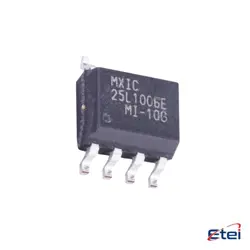
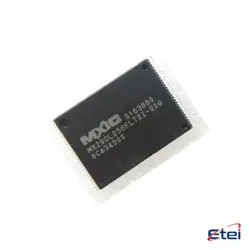
Imagens apenas para referência
TMS320C6713BGDP225
+Lista de MateriaisIC FLOATING POINT DSP 272-BGA
-
FabricanteTexas Instruments
-
Peça do Fabricante #TMS320C6713BGDP225
-
Pacote BGA-272
-
Em Estoque2960
365 Garantia de Qualidade em 1 dia
7*24 Garantia de serviço em 24 horas
90-Garantia de pós-venda em 1 dia
Garantia de Produto Genuíno
Especificações
| Atributo | Valor |
| Package / Case | Bulk,Tray |
| Series | TMS320C67x |
| Part Status | Active |
| Type | Floating Point |
| Interface | Host Interface, I²C, McASP, McBSP |
| Clock Rate | 225MHz |
| Non - Volatile Memory | External |
| On - Chip RAM | 264kB |
| Voltage - I / O | 3.30V |
| Voltage - Core | 1.26V |
| Operating Temperature | 0°C ~ 90°C (TC) |
| Mounting Type | Surface Mount |
Visão Geral
Description
Key features include a 32-bit floating-point unit, which enhances precision in mathematical computations, and a large on-chip memory for rapid data access. The processor supports multiple peripherals, such as multi-channel buffered serial ports (McBSPs), which are useful for interfacing with audio codecs and other serial devices. Its enhanced direct memory access (EDMA) controller facilitates efficient data handling without CPU intervention.
Due to its robust processing abilities and versatile interface options, the TMS320C6713BGDP225 is widely used in applications such as audio and speech processing, telecommunications, and industrial control systems. Its development environment is supported by Texas Instruments' Code Composer Studio, offering a comprehensive suite for debugging and optimization.
Equivalent
1. TMS320C6713BGDP200 - A lower clock speed variant of the same family.
2. ADSP-21371 from Analog Devices - Provides similar DSP capabilities.
3. SHARC processors from Analog Devices - Offer comparable processing power for signal processing tasks.
4. Freescale's MSC8126 - Another DSP alternative suitable for similar applications.
Always check the specific requirements and features needed for your application when selecting an equivalent.
Features
1. Floating-Point Architecture: It supports high-precision calculations essential for applications like audio processing and control systems.
2. Performance: Operates at up to 225 MHz, providing up to 1350 million floating-point operations per second (MFLOPS).
3. Memory: Equipped with 256 KB of on-chip RAM, which includes both program and data memory.
4. Enhanced Direct Memory Access (EDMA): Facilitates efficient data transfers, reducing CPU load and improving system performance.
5. Peripheral Interfaces: Includes multichannel buffered serial ports (McBSPs), host-port interface (HPI), and general-purpose input/output (GPIO) pins for versatile connectivity.
6. Power Management: Features low power consumption modes, making it suitable for portable and power-sensitive applications.
7. Development Support: Compatible with Texas Instruments' Code Composer Studio for streamlined development and debugging.
The TMS320C6713BGDP225 is ideal for applications requiring efficient, high-speed processing and versatile interfacing capabilities.
Pinout
Key features of the TMS320C6713 include:
- High-performance VLIW architecture with eight functional units.
- Operates at a clock speed of up to 225 MHz.
- 32-bit floating-point processing capability.
- On-chip memory includes 192 KB of RAM.
- Flexible connectivity options, including multi-channel buffered serial ports (McBSPs) and enhanced direct memory access (EDMA).
- Suitable for a wide range of applications due to its high computational power and efficient memory access.
The pinout includes power and ground pins, data and address bus lines, control signals, and various peripheral connections, all of which support its versatile functionality.
Manufacturer
Application
1. Audio Processing: Enhancing sound quality in audio equipment, such as home theater systems and musical instruments.
2. Telecommunications: Used in modems and communication systems for signal modulation and demodulation.
3. Industrial Automation: Implemented in control systems for real-time processing and decision-making.
4. Medical Devices: Utilized in imaging systems and patient monitoring devices for accurate data analysis.
5. Speech Recognition: Processing audio inputs for voice-activated technologies.
6. Instrumentation: Employed in test and measurement equipment for precise data analysis.
These applications leverage the DSP's capabilities for floating-point arithmetic and high-speed data handling.