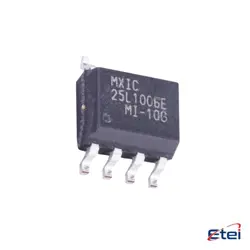
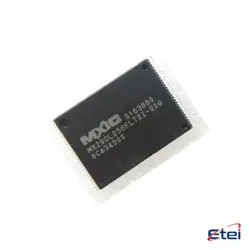
Imagens apenas para referência
EPM3256ATC144-10
+Lista de MateriaisIC CPLD 256MC 10NS 144TQFP
-
FabricanteIntel
-
Peça do Fabricante #EPM3256ATC144-10
-
Pacote LQFP-144
-
Em Estoque6471
365 Garantia de Qualidade em 1 dia
7*24 Garantia de serviço em 24 horas
90-Garantia de pós-venda em 1 dia
Garantia de Produto Genuíno
Especificações
| Atributo | Valor |
| Package / Case | Tray |
| Series | MAX® 3000A |
| Part Status | Obsolete |
| Programmable Type | In System Programmable |
| Delay Timetpd(1)Max | 10 ns |
| Voltage Supply - Internal | 3V ~ 3.6V |
| Number of Logic Elements/Blocks | 16 |
| Number of Macrocells | 256 |
| Number of Gates | 5000 |
| Number of I/O | 116 |
| Operating Temperature | 0°C ~ 70°C (TA) |
| Mounting Type | Surface Mount |
Visão Geral
Description
Key features of the EPM3256ATC144-10 include in-system programmability, low power consumption, and a flexible interconnect structure that allows for efficient logic design. It supports advanced functions such as combinatorial and sequential logic, state machines, and complex arithmetic operations. The device is designed to be used in a variety of applications, including telecommunications, data processing, and consumer electronics.
Development and programming of the EPM3256ATC144-10 can be accomplished using Altera's Quartus II design software, which provides a comprehensive environment for design entry, synthesis, simulation, and device programming. Overall, this EPLD offers a balance of performance, density, and ease of use for a wide range of digital logic applications.
Equivalent
Features
1. Logic Elements: Comprises 256 macrocells.
2. Architecture: Based on EEPROM technology, facilitating reprogrammability.
3. Speed: Offers a 10 ns pin-to-pin delay.
4. I/O Pins: Provides up to 116 user I/O pins.
5. Package: Available in a 144-pin TQFP package.
6. Low Power: Includes power-saving features like a standby mode.
7. Compatibility: Supports in-system programmability (ISP) and JTAG boundary-scan, aiding testing and debugging.
8. Temperature Range: Operates in a commercial temperature range of 0°C to 85°C.
9. Voltage Supply: Requires a 3.3V power supply.
This device is suitable for applications requiring moderate logic density, low power consumption, and reconfigurability, such as digital logic integration, control signal routing, and interface bridging.
Pinout
Key functions and features include:
- 256 macrocells for implementing complex logic designs.
- Non-volatile flash-based architecture, allowing for reprogrammability and data retention without power.
- A high pin count to support extensive I/O capability, suitable for a wide range of applications.
- Operating speed of up to 10 ns, supporting high-performance operations.
These features make the EPM3256ATC144-10 suitable for applications requiring significant logic capacity and flexibility, such as digital signal processing, device controllers, and communication equipment.
Manufacturer
Altera was founded in 1983 and became an influential player in the semiconductor industry, particularly within the realm of programmable logic solutions. Their products have been used in a wide range of applications across various sectors, including telecommunications, automotive, industrial, and consumer electronics.
In 2015, Altera was acquired by Intel Corporation for approximately $16.7 billion. Following the acquisition, Altera's products and technologies were integrated into Intel's broader product offerings, allowing Intel to expand its presence in the FPGA market and related fields. Today, these products continue to be developed and sold under the Intel brand as part of their Programmable Solutions Group.
Application
1. Prototyping and Development: Ideal for testing new designs and algorithms.
2. Embedded Systems: Used in systems requiring flexible and reconfigurable logic.
3. Signal Processing: Assists in custom digital signal processing tasks.
4. Control Systems: Employed for designing custom controllers and state machines.
5. Interface Logic: Facilitates interfacing between different hardware components.
These areas benefit from its programmability, speed, and high logic capacity.